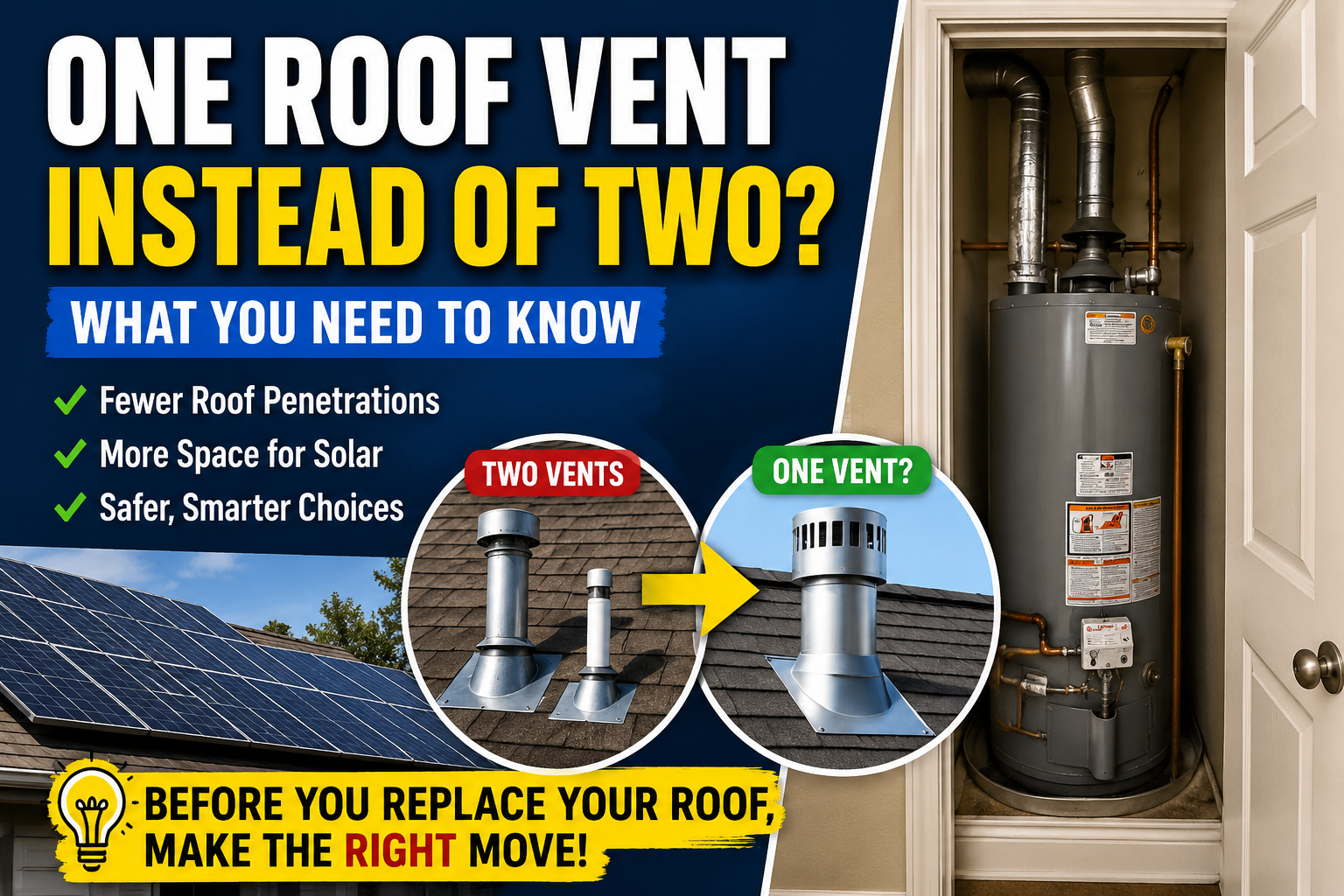
Can One Roof Vent Serve a Water Heater?
A roof replacement is a good time to rethink old plumbing and venting.
One homeowner had a 13-year-old, 40-gallon gas water heater.
The heater sat inside a small hallway closet.
The closet measured about 27 inches by 23 inches.
It also had a tight door with little bottom clearance.
The setup had two roof penetrations.
One vent removed flue gases from the gas burner.
The other brought in fresh air for combustion.
The roof also needed replacement soon.
The shingles were old T-Lock shingles in poor shape.
The homeowner wanted fewer roof holes before reroofing.
That makes sense, especially with metal roofing.
It also matters when solar panels are planned.
Every roof pipe can reduce clean panel space.
Question
Can you combine the exhaust vent and fresh air intake into one roof penetration?
Answer
Usually, no. You should not combine those vents on an existing gas water heater unless the heater is listed for that exact vent system.
A standard gas water heater needs safe exhaust removal.
It also needs enough combustion air.
Those rules protect your home from carbon monoxide.
A tight closet door can make this more important.
Gas appliances need air to burn fuel safely.
They also need a proper vent draft.
A poor draft can send exhaust back indoors.
That can create a serious safety risk.
The International Code Council explains combustion air rules for gas appliances.
These rules often apply to closets and small rooms.
You should also follow the water heater manual.
Local code may add more rules.
Is There A One-Pipe Product?
There are concentric vent systems for some gas appliances.
These systems can use one roof or wall opening.
They often place intake air and exhaust in one assembly.
DuraVent makes concentric venting products for approved appliances.
Some direct-vent water heaters also use coaxial venting.
A. O. Smith explains direct-vent and power-vent options.
But this does not mean your current heater can use one.
Older atmospheric gas water heaters are usually not convertible.
The vent system must match the appliance listing.
It must also match the maker’s instructions.
Best Options Before Replacing The Roof
First, have a licensed plumber inspect the heater.
Ask if it is atmospheric, power-vented, or direct-vented.
Also, ask about closet combustion air.
The small closet and tight door matter.
Second, price a new sealed-combustion gas water heater.
This may reduce venting issues.
It may also allow a cleaner roof layout.
Third, consider an electric tank water heater.
This removes gas exhaust venting.
It may need a larger electrical circuit.
Fourth, consider a heat pump water heater.
ENERGY STAR notes that heat pump models need proper airflow.
They may also need condensate drainage.
That can be hard in a tiny closet.
My Take
Do not modify the existing vents just to save roof space.
That can create unsafe venting.
Use the reroofing project as a planning point.
Choose the water heater first.
Then design the roof penetrations around it.
This avoids paying twice for roof flashing.
It also keeps the system safer.
A permit and inspection are worth it here.
Gas venting is not a good place to guess.