Can Fernco Hide Behind Drywall?
A small vent pipe repair can raise a big code question.
The question sounds simple at first.
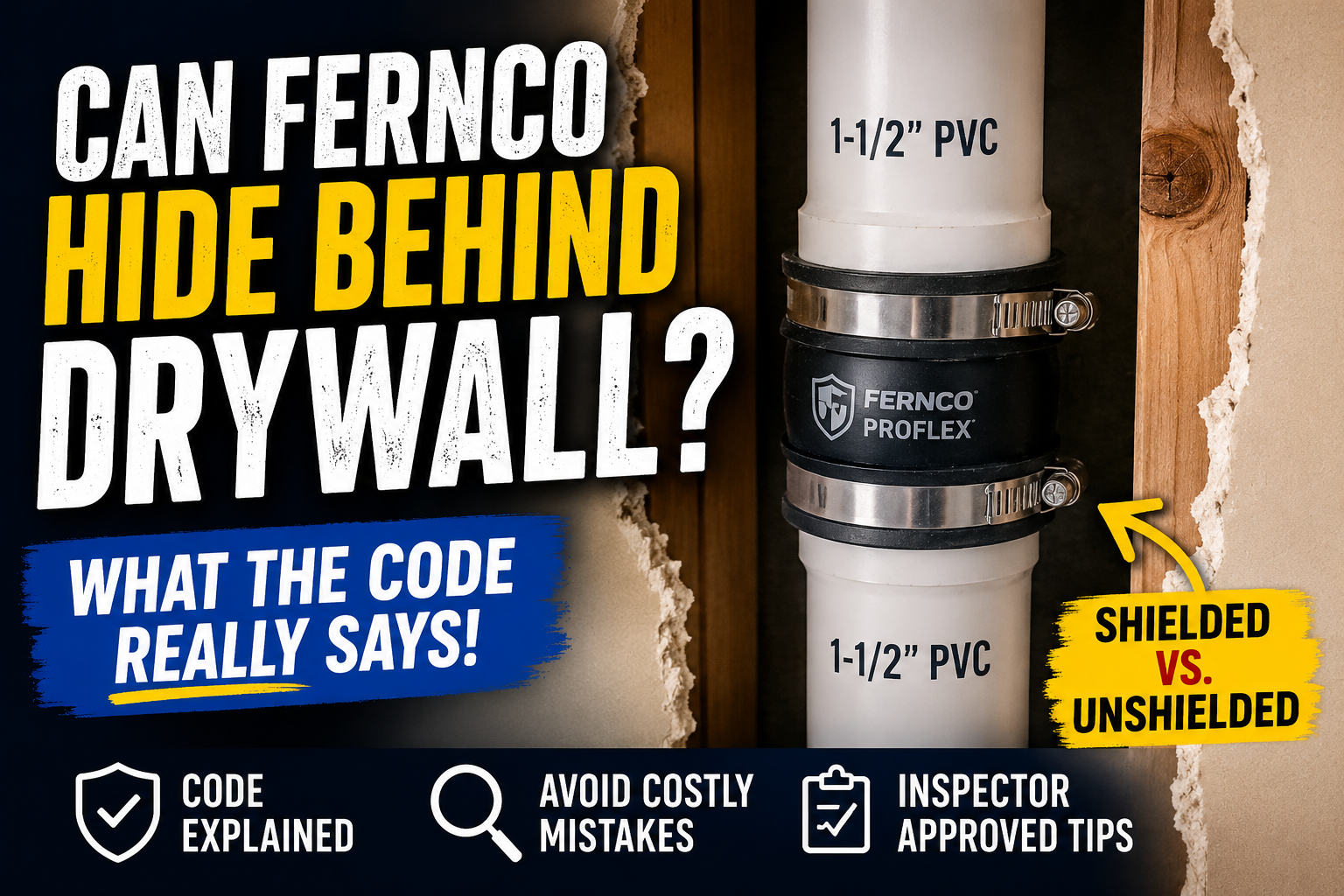
Can you join two pieces of 1-1/2 inch PVC vent pipe with a flexible Fernco coupling?
And can that coupling stay hidden behind sheetrock?
Under the Uniform Plumbing Code, the safe answer is usually clear.
Question
Can I join two sections of 1-1/2 inch PVC vent pipe with a flexible Fernco coupling behind sheetrock?
Answer
Do not use a plain, unshielded flexible rubber coupling behind sheetrock for an above-ground PVC vent repair. Use a shielded coupling approved for above-ground DWV use, or use a solvent-welded PVC repair coupling when possible.
A vent pipe is part of the DWV system.
DWV means drain, waste, and vent.
Even though a vent carries air, it still must meet plumbing code.
A plain rubber sleeve can flex too much.
It can also let the pipe ends shift over time.
That matters when the joint is hidden inside a wall.
A shielded coupling has a stainless steel band around the rubber sleeve.
The shield helps keep both pipe ends aligned.
It also gives the joint better shear support.
That is why inspectors often reject unshielded couplings above ground.
For a PVC-to-PVC vent repair, solvent welding is often the cleanest fix.
Use a listed PVC coupling if the pipe can move enough.
If the pipe cannot move, use an approved shielded repair coupling.
Match the coupling to the pipe size and material.
Also, follow the torque rating from the maker.
Do not guess with a nut driver.
A small torque wrench is a better tool.
You should also check your local plumbing office.
Local amendments can change the final answer.
The local inspector is the authority before the wall is closed.
Helpful Resources
Bottom Line
If the joint is above ground and hidden, use the safer code path.
Use a shielded coupling listed for that use.
Or use a proper solvent-welded PVC fitting.
Do not bury a plain flexible rubber coupling behind drywall.
That repair may work today.
But it can fail inspection later.
It can also make future wall repair harder.
When in doubt, choose the shielded fitting.
Then ask the inspector before closing the wall.
I’m Chris Mayer, writing for Plumbing 101.