Faucet Supply Line Length: Avoid Costly Leaks
Picking the right faucet supply line length sounds simple.
But it matters more than many homeowners think.
A line that is too short can pull on fittings.
A line that is too long can loop, twist, or kink.
Both problems can lead to leaks under your sink.
Question
What is the best length for faucet sink supply lines?
How much slack should they have?
Can they be too long?
Answer
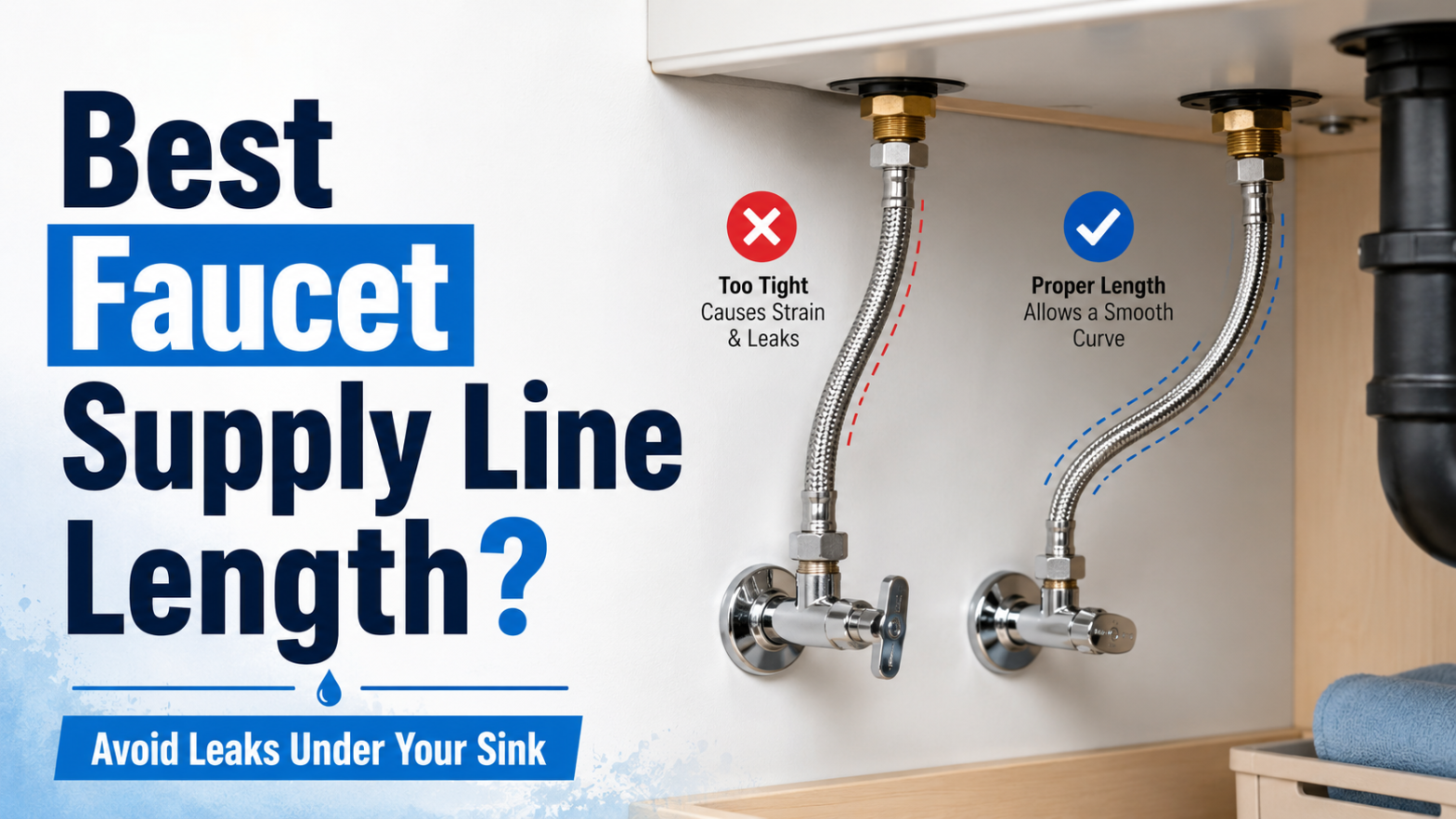
The best faucet supply line is long enough to make a smooth, relaxed curve.
Leave about 2 to 4 inches of extra slack when possible.
The line should not be tight, twisted, kinked, or sharply bent.
Most bathroom and kitchen sinks use flexible braided supply lines.
Common lengths include 12, 16, 20, 24, and 30 inches.
The right choice depends on your faucet and shutoff valve location.
Measure from the faucet connection to the shutoff valve.
Then choose the next longer standard size.
This gives the line room to bend gently.
Do not stretch a supply line too tightly.
A tight line can stress the faucet nut.
It can also pull on the shutoff valve.
That stress may cause small leaks later.
Too much length can also be a problem.
A long line may form a large loop.
That loop can rub against cabinet items.
It may also bend too sharply near the fitting.
Use a clean curve instead of a hard bend.
A smooth curve helps water flow better.
It also helps protect the inner hose.
Simple Rule For Homeowners
Use the shortest line that connects easily.
It should reach without pulling tight.
It should also avoid big loops.
For many sinks, a 16-inch or 20-inch line works well.
A 12-inch line may work for close valves.
A 24-inch line may work for lower valves.
Always check the fitting sizes before buying.
Many faucets use 1/2-inch faucet connections.
Many shutoff valves use 3/8-inch compression outlets.
Your setup may be different.
Helpful External Resources
BrassCraft explains water connector options on its water connectors page.
PlumbingSupply shows common braided connector sizes on its braided flex line guide.
You can also compare common lengths at The Home Depot.
Final Tip
Turn the water on slowly after installation.
Dry the fittings with a towel.
Then check for drips after a few minutes.
Check the next day again.
Good supply lines should look relaxed.
They should not look stretched or crushed.
When in doubt, choose a clean, gentle curve.
I’m Chris Mayer, writing for Plumbing 101.