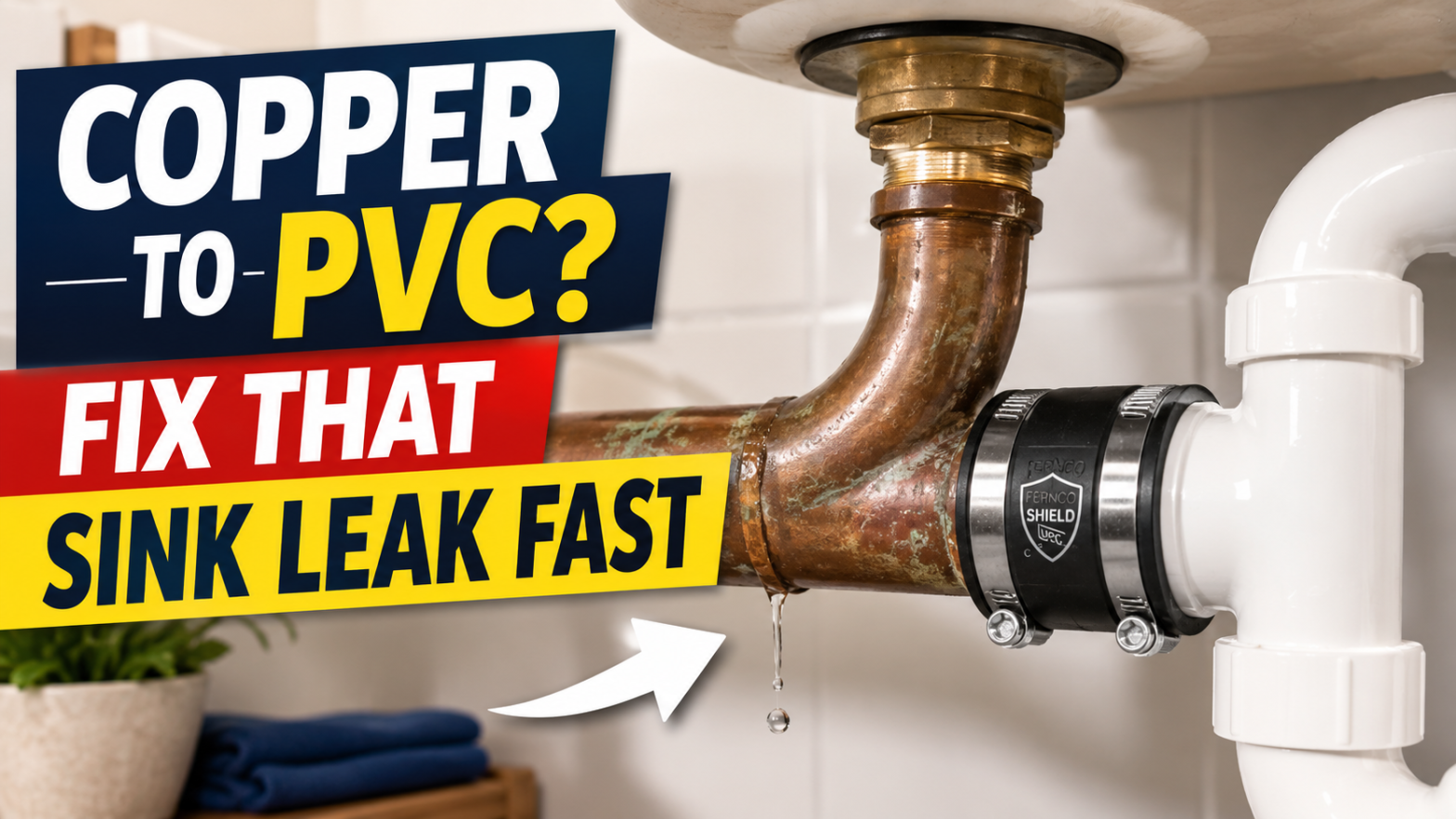
A leaking bathroom sink drain can feel confusing fast.
That is true when old copper meets newer PVC pipe.
The hard part is not always the repair.
The hard part is buying the right coupling.
Question
I have a leaking copper drain pipe for a bathroom sink.
I want to replace part of it with PVC.
The copper pipe measures 1 3/8 inches outside.
The PVC pipe measures 1.66 inches outside.
What flexible rubber coupling should I buy?
Answer
Buy a shielded transition coupling listed for 1-1/4 inch plastic or steel
to 1-1/4 inch copper. A Mission K-1125 style coupling is the kind to ask for.
Measure both pipes before you tighten them.
Why The Size Looks Strange
Your copper pipe is not measured like a PVC pipe.
That is why the numbers do not match.
A 1-1/4 inch copper drain can measure about 1 3/8 inches outside.
A 1-1/4 inch Schedule 40 PVC pipe can measure about 1.66 inches outside.
So, do not buy only by the name on the package.
Buy by the pipe material and outside diameter.
Use A Shielded Coupling
A plain rubber sleeve may seem easy.
But a shielded coupling is usually the better choice indoors.
The metal band helps keep both pipes lined up.
It also helps stop the joint from sagging.
This matters on a bathroom sink drain.
That drain still needs a steady slope after the repair.
You can read more about shielded couplings from Fernco.
What To Ask For
Ask for a shielded copper-to-plastic DWV transition coupling.
Tell the supplier your actual pipe sizes.
Say the copper is 1.375 inches outside diameter.
Say the PVC is 1.660 inches outside diameter.
Mission Rubber lists K Series couplings for copper and plastic drain use.
You can compare the style at Mission Rubber.
Simple Repair Tips
Cut the copper pipe square.
Clean burrs from the cut end.
Dry fit the PVC before gluing.
Keep the pipe slope aimed toward the drain line.
Tighten the coupling bands to the listed torque.
Do not guess with a screwdriver.
Use a small torque wrench when possible.
For code details, check your local plumbing office.
You can also review model plumbing code resources from ICC Digital Codes.
Final Takeaway
The right part is not just a rubber coupling.
It should be a shielded transition coupling.
It must match copper on one side.
It must match PVC on the other side.
When in doubt, bring pipe samples to the supply house.
I’m Chris Mayer, writing for Plumbing 101.