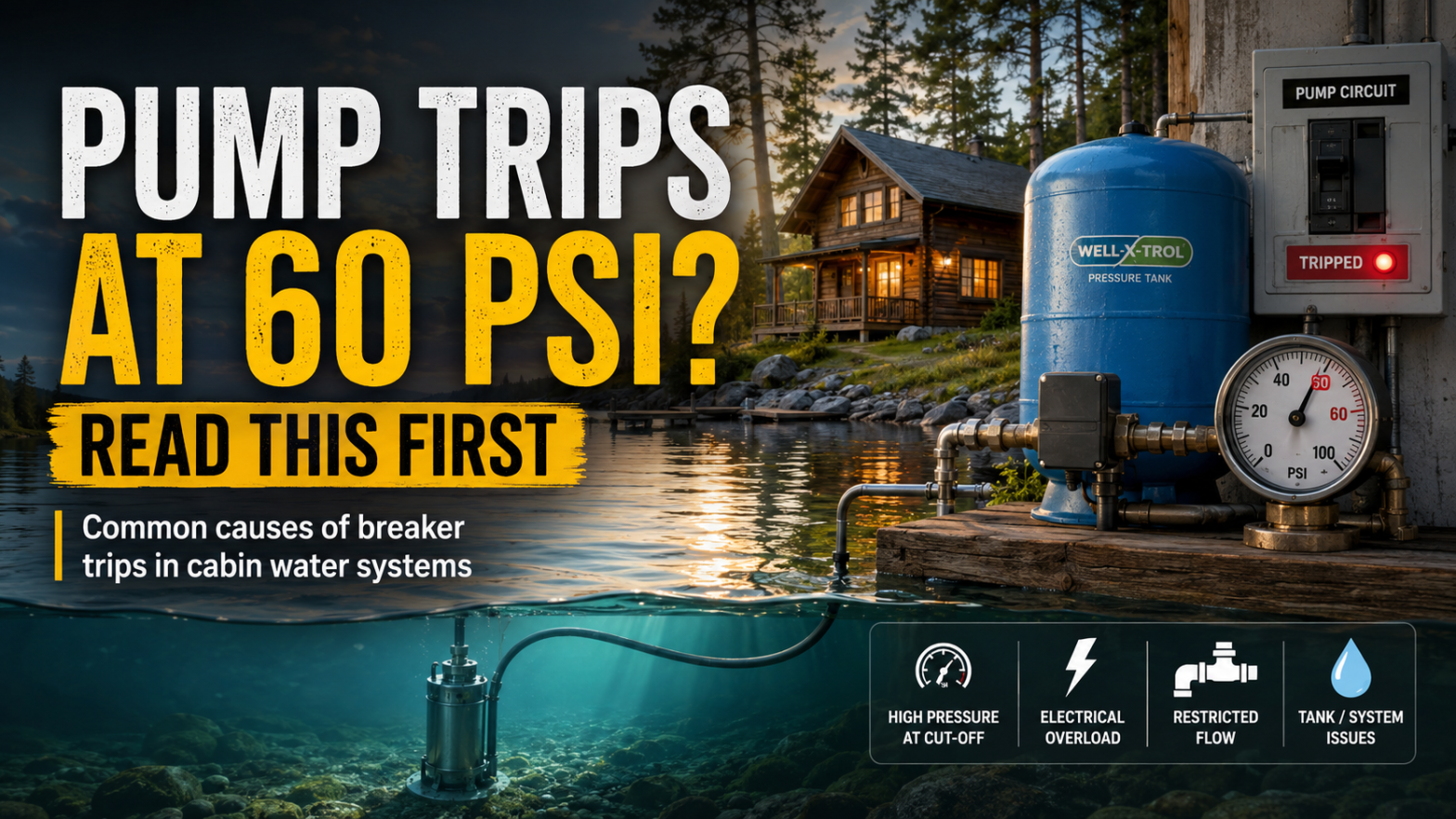
Pump Trips Breaker at 60 PSI? Try This First
Why Does My Cabin Pump Trip the Breaker Near 60 PSI?
An off-grid cabin water system can be simple.
But it can also be hard to diagnose.
This is common with lake-fed water systems.
One cabin owner has a submersible pump in the lake.
The pump feeds a pressure tank inside the cabin.
The pump is a Red Lion RL12G05-2W1V model.
It is a 1/2 HP, 115-volt, two-wire submersible pump.
The pump is connected to a dedicated 15-amp breaker.
Each time water is used, the pump starts fine.
It fills the pressure tank almost to 60 PSI.
Then the breaker trips near the end of the cycle.
This happens every time.
Question
Why would a submersible lake pump trip the breaker right before reaching 60 PSI?
Answer
The most likely causes are high amp draw, a weak pump motor, damaged pump wiring, a bad underwater splice, low voltage, or a pump clogged with lake silt.
The clue is important here.
The breaker does not trip when the pump wires are disconnected.
That points away from the panel and the pressure switch.
It points toward the pump, pump cable, or underwater connection.
What To Check First
Start with the safe and simple checks.
- Check the pump nameplate amp rating.
- Compare it to the breaker size.
- Measure voltage while the pump is running.
- Check amp draw near shutoff pressure.
- Inspect the pressure switch contacts.
- Inspect the wire run to the lake.
- Check any underwater splice kits.
A pump works harder as pressure rises.
So a weak motor may run at 30 PSI.
Then it may trip near 60 PSI.
Low voltage can also cause high amp draw.
Long wire runs make this problem worse.
Loose connections can heat up under load.
That can also trip the breaker.
Could Lake Silt Cause This?
Yes, lake silt could be part of the problem.
A pump sitting in a lake for two years can collect debris.
Silt may restrict the intake screen.
It may also make the motor work harder.
Pulling the pump is a smart next step.
Clean the intake screen and inspect the pump body.
Also, inspect the cable jacket for cuts or swelling.
Check the splice for water entry.
Do Not Ignore Breaker Trips
A breaker trip is a warning sign.
Do not keep resetting it again and again.
That can damage the pump.
It can also create an electrical risk near water.
For electrical safety basics, visit the NFPA electrical safety page.
You can also review pump support information from Red Lion.
For lake and private water system care, see the EPA private wells guide.
Best Next Step
Pull the pump when conditions are safe.
Clean it and inspect every wire connection.
Then test the pump with an amp clamp.
If the amps climb near 60 PSI, the pump may be failing.
If the amps look normal, focus on wiring and splices.
A pump technician or electrician can test this quickly.
That may save you from buying the wrong part.
I’m Chris Mayer, writing for Plumbing 101.