Basement Bath Drains: Simple, Code-Smart Layout
Question
I am remodeling a bathroom with a shared kitchen stack.
The lav and kitchen share a 2-inch line in the wall.
A 2-inch branch under the floor serves the tub or shower.
The toilet will sit over a 4-inch hub to the main drain.
How should I route drains and vents for a clean layout?
Where do cleanouts and transitions belong for inspection?
Answer
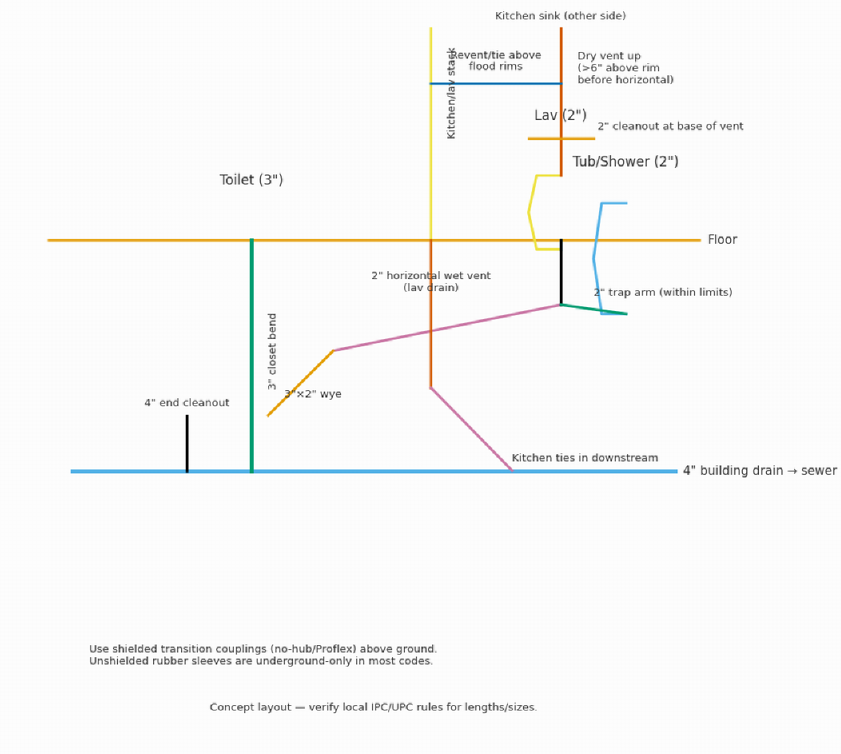
Use the lavatory’s 2-inch drain as the wet vent for the bathroom group. Keep the lav vent vertical to 6 inches above the highest flood rim before any horizontal run. Tie the tub’s 2-inch trap arm into the lav drain with a combo wye and 45. Bring the toilet’s 3-inch closet bend into the wet-vented line with a 3×2 wye, then into the 4-inch building drain. Keep the kitchen sink off the wet-vented section. Revent it above the flood rims or tie it downstream on the building drain. Install a 3-inch end cleanout at the upstream end and a 2-inch cleanout at the base of the lav vent. Use a shielded transition coupling for any PVC-to-galvanized connection above ground. Maintain 1/4 inch per foot slope on all horizontals.
Why this layout works
- Bathroom groups can be wet-vented when sized correctly.
- The lav carries air for the toilet and the tub trap arm.
- Keeping the kitchen separate avoids trap washout issues.
- Cleanouts simplify maintenance and camera access later.
- Shielded couplings prevent shear and keep joints aligned.
Key steps before you glue
- Confirm pipe sizes and vent heights for your code.
- Use wyes or combos on horizontals, not sanitary tees.
- Support pipe to preserve slope and avoid bellies.
- Measure trap-arm lengths against code limits.
- Map the 4-inch tie-in elevation before trenching.
Helpful resources
- Uniform Plumbing Code: wet venting and cleanouts
- International Code Council references
- Shielded transition couplings (PVC↔galvanized)
Check local amendments before you cut concrete.