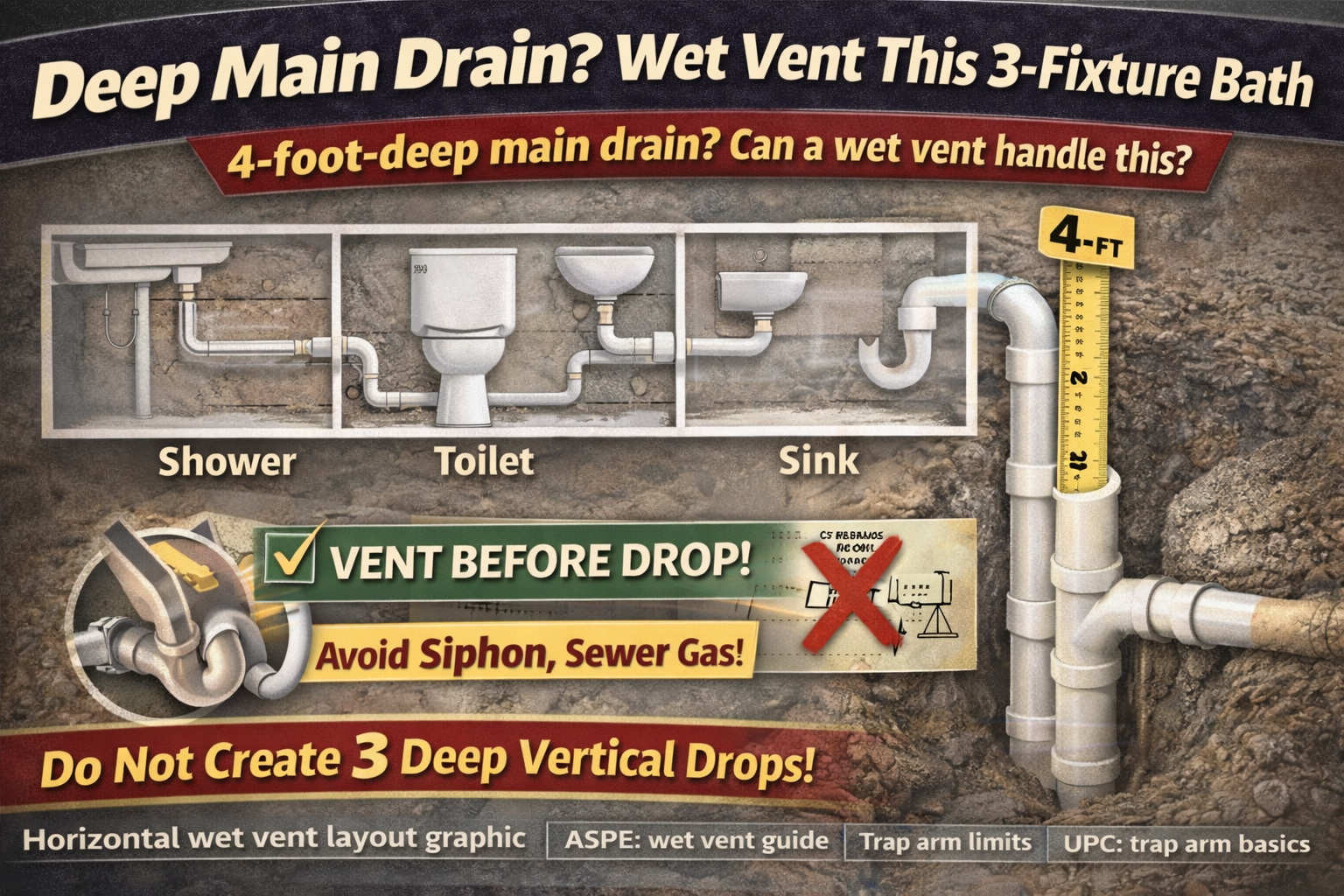
You have a tough bathroom rough-in.
The layout is shower, toilet, then sink.
The 4-inch main drain runs under the toilet.
It is also about 4 feet deep.
You are thinking about horizontal wet venting.
That can work for many bathroom groups.
But the details matter.
Quick Q&A
Q: Is a 4-foot vertical drop from the toilet “too much”?
A: No, not by itself. The key is vent distance and trap-arm rules, not the total drop to the main.
What “horizontal wet venting” means
One vent can protect more than one fixture.
In many designs, the lavatory is the dry vent.
The lav drain also acts as a wet vent.
That wet vent can serve the toilet and shower.
This is often called a “bathroom group” wet vent.
The rules that usually drive the layout
- All fixtures must be on the same floor level.
- The toilet tie-in must be downstream of the shower and sink drains.
- Trap arms must stay within code table limits.
- The wet vent pipe must be sized correctly.
Why are the big main changes in your plan
You do not need to dig 4 feet everywhere.
You only need full depth where you tie into the main.
The goal is a clean, sloped branch drain.
Then you “drop” once, near the main connection.
Do not create an S-trap on the shower or sink
The shower and sink have separate traps.
After the trap, keep the trap arm mostly horizontal.
Vent the trap arm before any big vertical drop.
A vertical drop before venting can siphon the trap.
That can lead to sewer gas smells.
A layout that often passes inspection
This is a common “one-bath group” approach.
- Run the lavatory drain to a sanitary tee in the wall.
- Take the vent up from that tee.
- Continue the lav drain as a 2-inch wet vent line.
- Bring the shower drain into that wet vent line with a wye.
- Connect the toilet last, downstream, with a combo wye and 45.
- After the wet-vented section, drop to meet the deep 4-inch main.
Use long sweeps where the flow turns.
Plan a cleanout where you can reach it.
Future you will be glad.
What about “three vertical drops” to the main?
It sounds simple, but it is risky.
The shower and sink still need vent protection.
They cannot just drop 4 feet unvented.
You can drop after the vented section.
But vent first, then drop.
Key measurements to confirm
- Toilet trap arm length, from flange to vent connection.
- Shower trap arm length, from trap weir to vented line.
- Lav trap arm length, from the trap weir to the vent tee.
- Wet vent pipe size, based on DFUs.
Helpful external resources
- Horizontal wet vent diagram and notes
- ASPE guide to wet and circuit venting
- Trap arm limits and rough-in checklist
- UPC trap arm basics and water closet notes
Codes vary by area.
If this is permitted work, ask your inspector early.
Bring a simple sketch with pipe sizes and distances.
I’m Chris Mayer, writing for Plumbing 101.