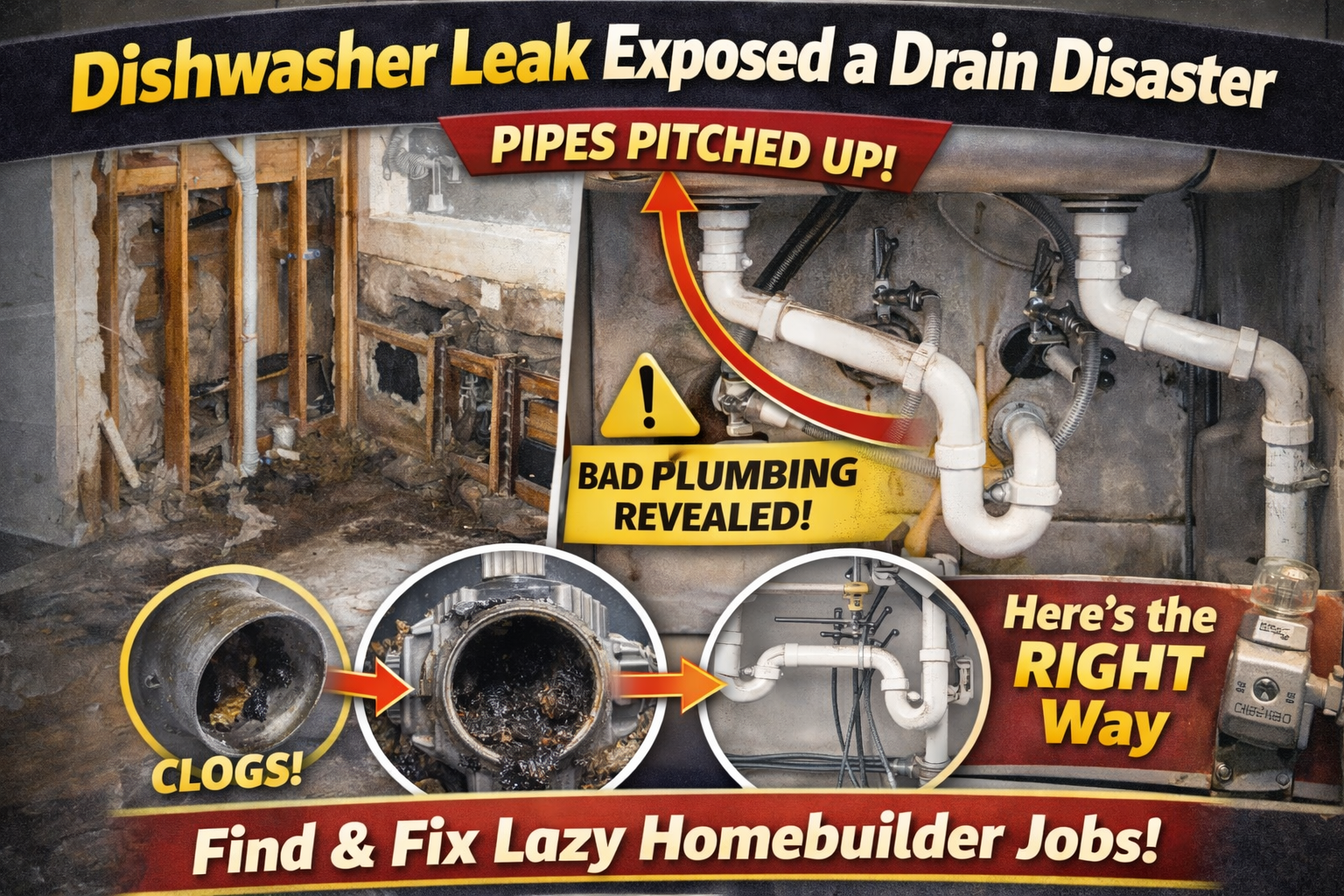
A former neighbor in Michigan had a dishwasher leak.
It started as a small mess under the sink.
Then it turned into a full tear-out.
They decided to rebuild the kitchen anyway.
It was long overdue.
During the demo, they found something shocking.
The old two-bowl sink had two separate drain lines.
Each line was pitched the wrong way.
The pipes ran uphill.
Yes, uphill.
Quick Q&A
Q: Why is “uphill pitch” on a sink drain a big problem?
A: Waste water slows down, solids settle, and clogs form fast.
Why this “worked” until it didn’t
Bad plumbing can hide for years.
Grease and soap coat the pipe walls.
The pipe gets smaller inside over time.
Then one event pushes it over the edge.
A dishwasher leak is often that event.
Dishwashers also send hot water and food bits.
If the drain is already slow, trouble grows.
Water finds seams, wood, and drywall.
Damage spreads quietly.
What the correct drain slope should look like
Most drains need a steady downhill slope.
A common target is 1/4 inch per foot.
That keeps water moving at a good speed.
It also helps carry solids away.
If a line pitches up, it can trap water.
That trapped water holds debris.
It also causes odors and gurgling.
Red flags you can spot under a sink
- Long horizontal runs that look level.
- Pipe runs that rise before they drop.
- Two separate traps for a two-bowl sink.
- “S-trap” shapes that dive into the floor.
- Constant clogs, even with careful use.
The right way to plumb a two-bowl sink
In most homes, both bowls join above one trap.
A continuous waste kit often connects the bowls.
Then one P-trap serves the sink.
The trap arm runs to a vented connection.
That connection is usually a sanitary tee in the wall.
Here are helpful visuals and guides:
- This Old House: Double sink plumbing basics
- Family Handyman: Kitchen sink drain layouts
- IRC code reference for residential plumbing
What I would do during a remodel
- Remove all wrong piping back to the wall stub.
- Confirm the wall drain is solid and vented.
- Set the trap arm with a steady downhill slope.
- Use the correct fittings for direction changes.
- Pressure test and run water for ten minutes.
Bad subs can leave bad surprises.
The good news is simple.
A remodel is the best time to fix it right.
I’m Chris Mayer, writing for Plumbing 101.