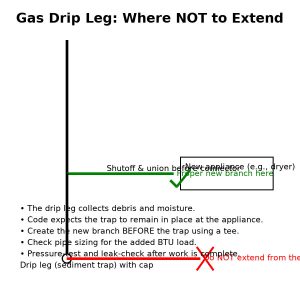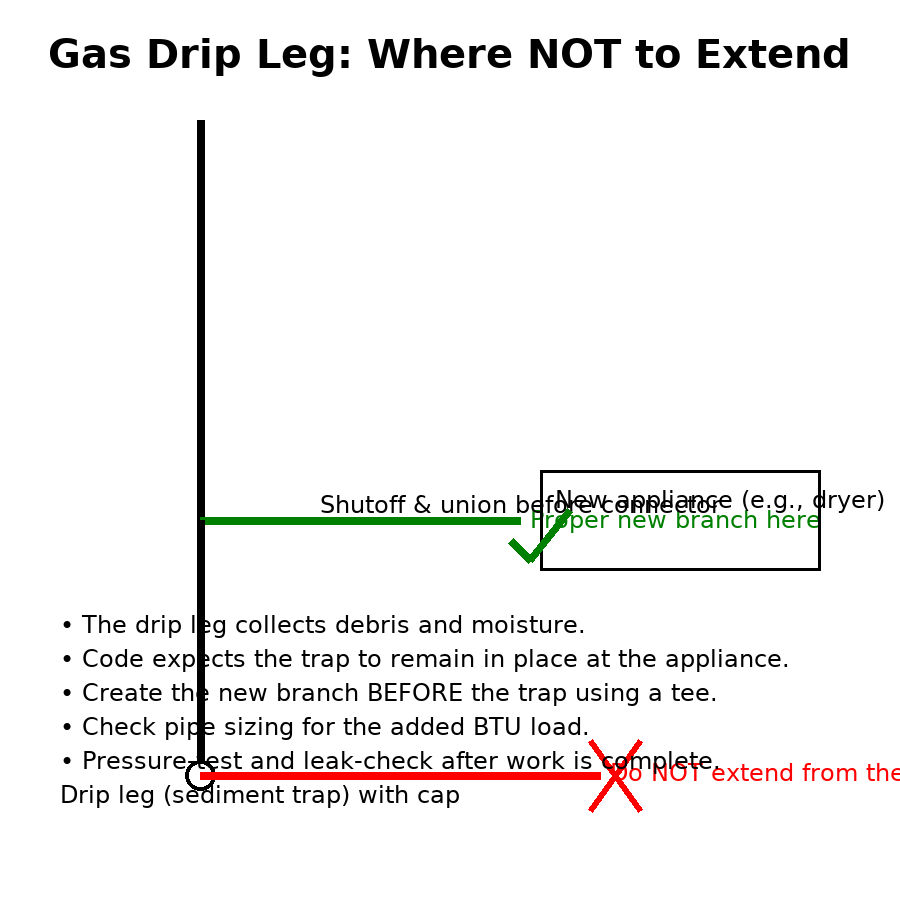
Don’t Extend From a Gas Drip Leg—Here’s Why (plumbing101.i234.me)
You asked: A plumber wants to remove the plug in the drip leg and run a 17-foot gas line to a basement laundry room. Is that okay?
Quick Answer
No. You should not extend a new branch from a drip leg.
What a Drip Leg Does
A drip leg (also called a sediment trap) collects debris and moisture before gas reaches the appliance. The plug is there for cleaning. It is not a take-off point.
What Code Expects (In Plain English)
- Keep a drip leg at each appliance that needs one.
- Do not branch from the trap or its cap.
- Run your new line from a proper tee before the trap.
- Use approved gas piping and fittings for the whole run.
- Leak test and pressure test the system after work.
Better, Safer Plan for Your 17-Foot Run
- Shut off gas and verify the line is safe to work on.
- Cut in a tee on the supply line upstream of the drip leg.
- Pipe the new branch to the laundry location with the right supports.
- Add a shutoff valve, union, and connector at the appliance.
- Install a new drip leg at the appliance as required.
- Perform code-compliant testing and inspection.
Sizing and Testing Tips
Gas lines must be sized for total BTU load and length. A 17-foot branch may need upsizing depending on what else the line serves. Always follow your local code and manufacturer instructions. A licensed pro should perform the pressure test and document results for inspection.
Helpful Resources
- International Fuel Gas Code (IFGC) – Read-only access
- Call 811 – Utility locate and safety info
- U.S. DOE Energy Saver – Natural Gas basics
Q & A
Q: Can I legally remove the plug in the drip leg and run my new line from there?
A: No. That cap is for cleaning. Extend from a tee before the trap, keep the trap at the appliance, and test the system.

When in doubt, hire a licensed gas-fitting contractor and pull a permit. It keeps you safe and protects insurance coverage.
I’m Chris Mayer, writing for Plumbing 101.