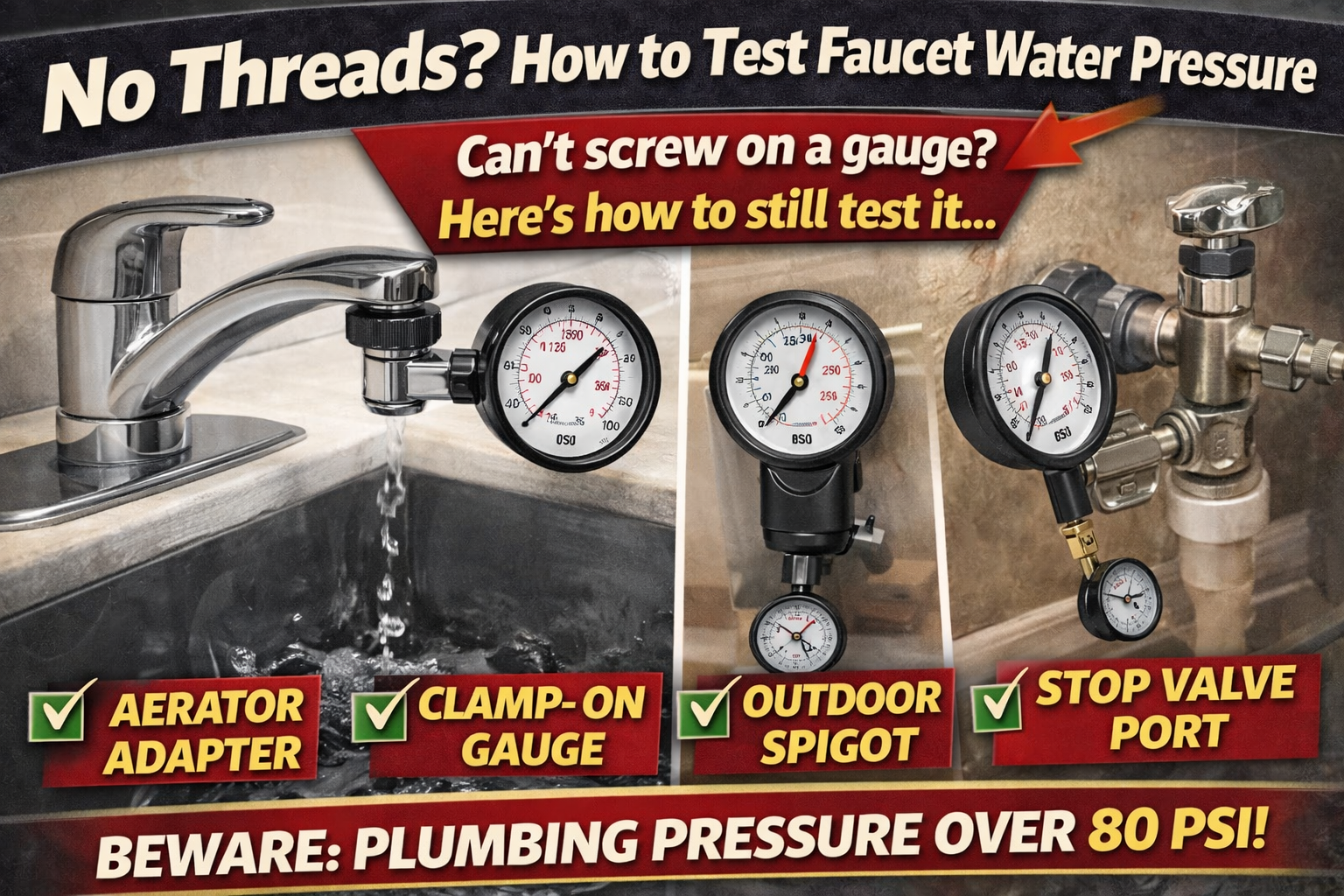
You want to check the water pressure at a faucet.
But the spout has no hose threads.
A standard gauge will not screw on.
Good news.
You still have several easy options.
Quick Q&A
Q: How can I measure pressure without faucet threads?
A: Use an aerator adapter, a clamp-on faucet gauge, or test pressure at the shutoff valve under the sink.
Start with the simple question
Does the faucet have an aerator at the tip?
Most kitchen and bath faucets do.
The aerator often hides the threads you need.
Option 1: Remove the aerator and use an adapter
Unscrew the aerator by hand.
Use a rubber jar pad for grip.
If it is stuck, use an aerator key.
Once removed, check the thread style.
Common aerator sizes include M24, M22, and 55/64.
You can buy a small adapter kit.
Then you can connect a gauge safely.
Option 2: Use a “clamp-on” faucet pressure gauge
Some gauges use a rubber cone seal.
You press it against the spout outlet.
It can work on smooth, unthreaded faucets.
It is best for quick checks.
It can be less accurate than a threaded gauge.
Hold it steady during the test.
Option 3: Test at a threaded hose bib instead
If you have an outdoor spigot, use that.
It has standard hose threads.
This gives a good “whole house” reading.
It will not show a pressure drop inside the faucet.
But it tells you if the pressure is too high.
Many plumbing rules treat 80 PSI as a limit.
Higher pressure can cause leaks and noise.
This overview explains the common limit:
Option 4: Add a temporary test point under the sink
This is the most accurate option for that fixture.
Shut off the angle stop under the sink.
Open the faucet to relieve pressure.
Install a small tee with a 1/4-inch gauge port.
Then turn the stop back on slowly.
Read the static pressure with no water running.
Read the dynamic pressure with the faucet running.
If pressure jumps while heating water, note it.
That can point to thermal expansion.
This overview explains the idea in plain terms:
How to record your results
- Static pressure: no fixtures running.
- Flowing pressure: one faucet running steadily.
- Peak pressure: after the water heater heats.
If you see readings near 80 PSI or higher, act.
A PRV may need service or replacement.
I’m Chris Mayer, writing for Plumbing 101.