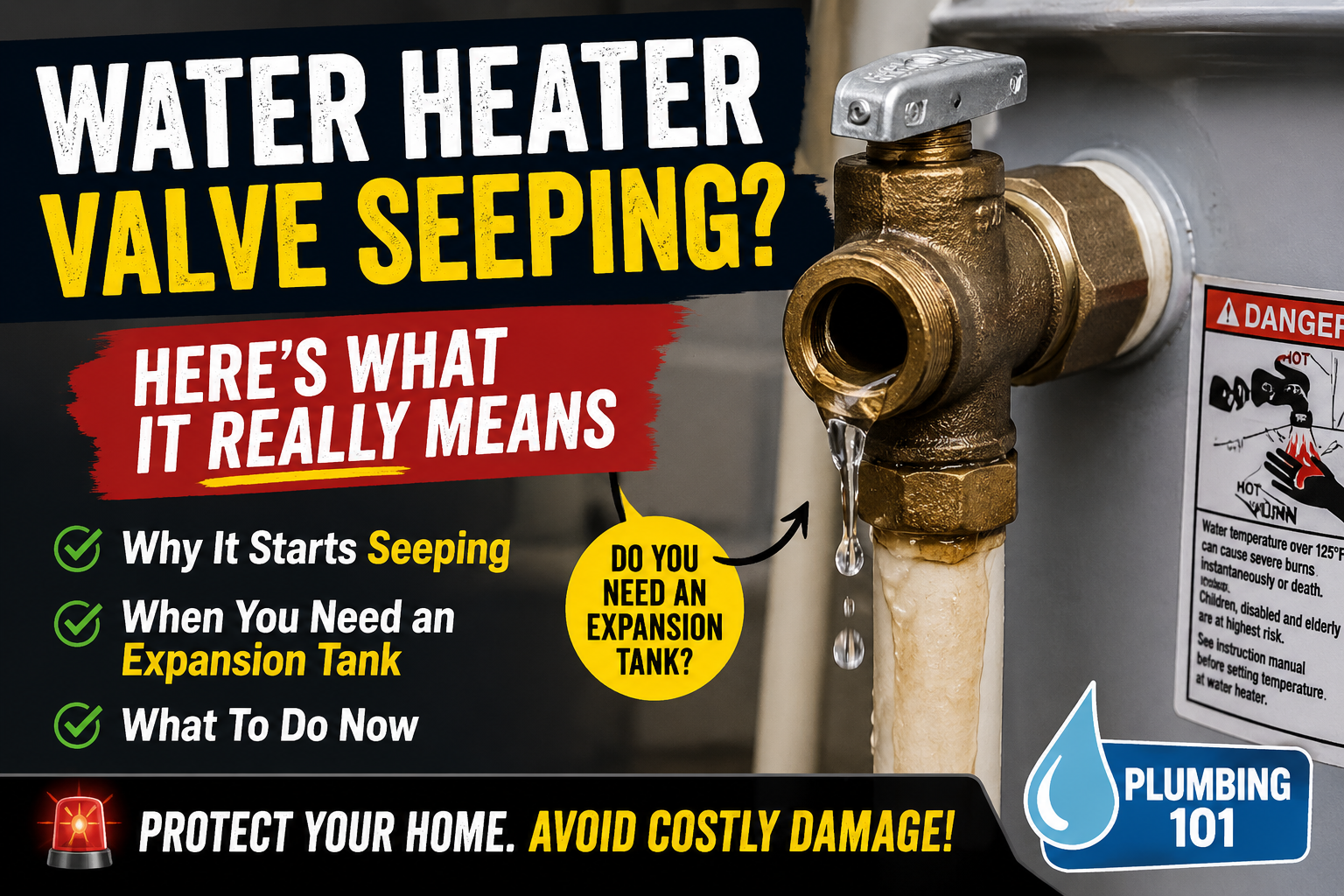
Water Heater Valve Seeping? Check This First
A seeping pressure relief valve on a water heater should never be ignored.
That small drip may look harmless at first.
But it can point to pressure trouble inside your plumbing system.
It can also mean the relief valve is worn out.
The valve is often called a T&P valve.
That means a temperature and pressure relief valve.
Its job is simple, but very important.
It opens when the tank gets too hot or too pressurized.
This helps protect the water heater from unsafe pressure.
Question
My water heater relief valve recently started seeping.
It has not leaked during the five years I have lived here.
The water heater has no expansion tank.
Do I need one now?
Answer
Yes, you may need an expansion tank if your home has a closed plumbing system.
A closed system can trap expanding hot water.
That trapped pressure can make the relief valve seep.
But the valve itself may also be failing.
A plumber should test the water pressure before replacing parts.
Why It May Start After Years
A system can work fine for years.
Then one change can expose a pressure problem.
Your water supplier may have changed the meter.
A check valve may have been added.
A pressure-reducing valve may have started working differently.
Any of these can create a closed system.
When cold water heats, it expands.
In an open system, that extra pressure can move backward.
In a closed system, it has nowhere to go.
The relief valve may then drip or seep.
What To Check First
- Check your home water pressure.
- Watch the pressure while the heater runs.
- Look for a pressure-reducing valve.
- Look for a check valve near the meter.
- Check the water heater temperature setting.
- Replace a weak relief valve if needed.
Do not plug the relief valve.
Do not cap the drain line.
That valve is a safety device.
Blocking it can create a dangerous condition.
When An Expansion Tank Helps
An expansion tank gives heated water room to expand.
It is usually installed on the cold water line.
It must be sized for your water heater and pressure.
It also needs the correct air charge.
If the charge is wrong, the tank may not help.
Local code may also require thermal expansion control.
You can read more in the 2024 International Plumbing Code.
A.O. Smith also explains relief valve seepage and thermal expansion in this technical bulletin.
The U.S. Department of Energy also suggests that many homes use a 120°F setting.
You can review their advice on lowering the water heater temperature.
Bottom Line
A seeping relief valve is a warning sign.
It does not always mean the tank is bad.
It may mean pressure has changed in your system.
It may also mean the valve is worn.
If your plumbing is now closed, add a proper expansion tank.
Also, replace the relief valve if it no longer seals.
A licensed plumber can test both issues quickly.
That is safer than guessing.
I’m Chris Mayer, writing for Plumbing 101.