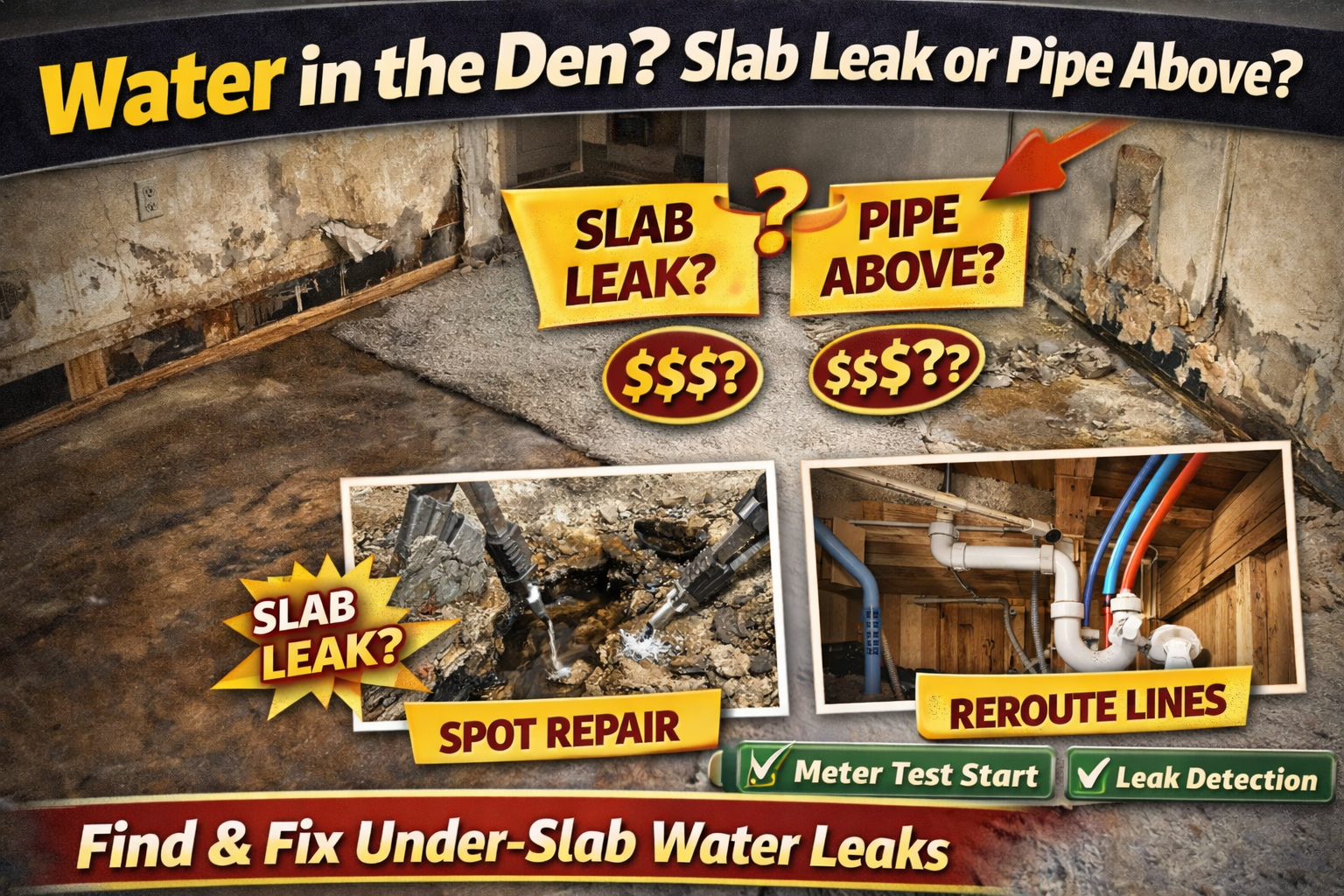
You’re looking at a house as a rental.
You walk in and find water in the den.
The break is “underneath,” but the source is unknown.
It could be a supply line under the slab.
It could be a drain line in the slab.
It could also be a pipe above the slab.
Quick Q&A
Q: If the leak is under the slab, how do you run a new water line?
A: Many plumbers abandon the bad line and run new PEX through walls or the attic, then drop down to each fixture.
Step one: confirm if it’s an active supply leak
Start with one simple test.
Turn off every faucet and appliance.
Then watch the water meter leak indicator.
If it moves, you likely have a supply leak.
This helps before any demo begins.
Here’s a quick guide to reading the meter:
How to read a water meter to catch hidden leaks.

Step two: figure out the hot side or the cold side
Shut off the water heater feed valve.
Run a cold faucet for a minute.
Watch the meter again.
No movement can point to a hot-side issue.
Movement can still mean cold supply.
Step three: Locate the leak before choosing a repair
Slab leaks are often found with special tools.
Pros may use acoustic listening or thermal imaging.
That helps avoid “guess and break” repairs.
These are common detection approaches:
Ways plumbers detect under-slab leaks.
Repair choices that usually make sense
Option A: Spot repair in the slab
This is the “open the slab and fix it” route.
It can be the lowest material cost.
But access can be messy and loud.
Cost varies by location and access.
Some guides put many repairs in the low thousands. :contentReference[oaicite:0]{index=0}
Option B: Reroute the line and abandon the old one
This is common when pipes are aging.
It also helps avoid cutting the slab again later.
Reroutes may run through walls or the attic.
Then the plumber drops lines to the fixtures.
Home cost guides often list reroutes in the hundreds to a few thousand.
Option C: Partial or full repipe
This is a bigger job, but it can end repeated leaks.
PEX is often used for reroutes and repipes.
Some estimates put PEX repipes in the mid-thousands to five figures.
What I’d do before buying it as a rental
- Get the leak confirmed with a meter test and inspection.
- Have a leak detection company pinpoint the area.
- Ask for two bids: spot repair and reroute.
- Ask what drywall and flooring must be removed.
- Plan drying fast to reduce mold risk.
Standing water can hide under floors.
So the “how long” question matters a lot.
If you can, inspect with a moisture meter.
Also, check baseboards and drywall edges.
A simple rule for the decision
If the home has one known leak point, spot repair may work.
If the piping is old or failing, a reroute or repipe is safer.
Ask the plumber what pipe material is in the slab.
That often changes the best plan.
For cost and method overviews, these are useful:
I’m Chris Mayer, writing for Plumbing 101.