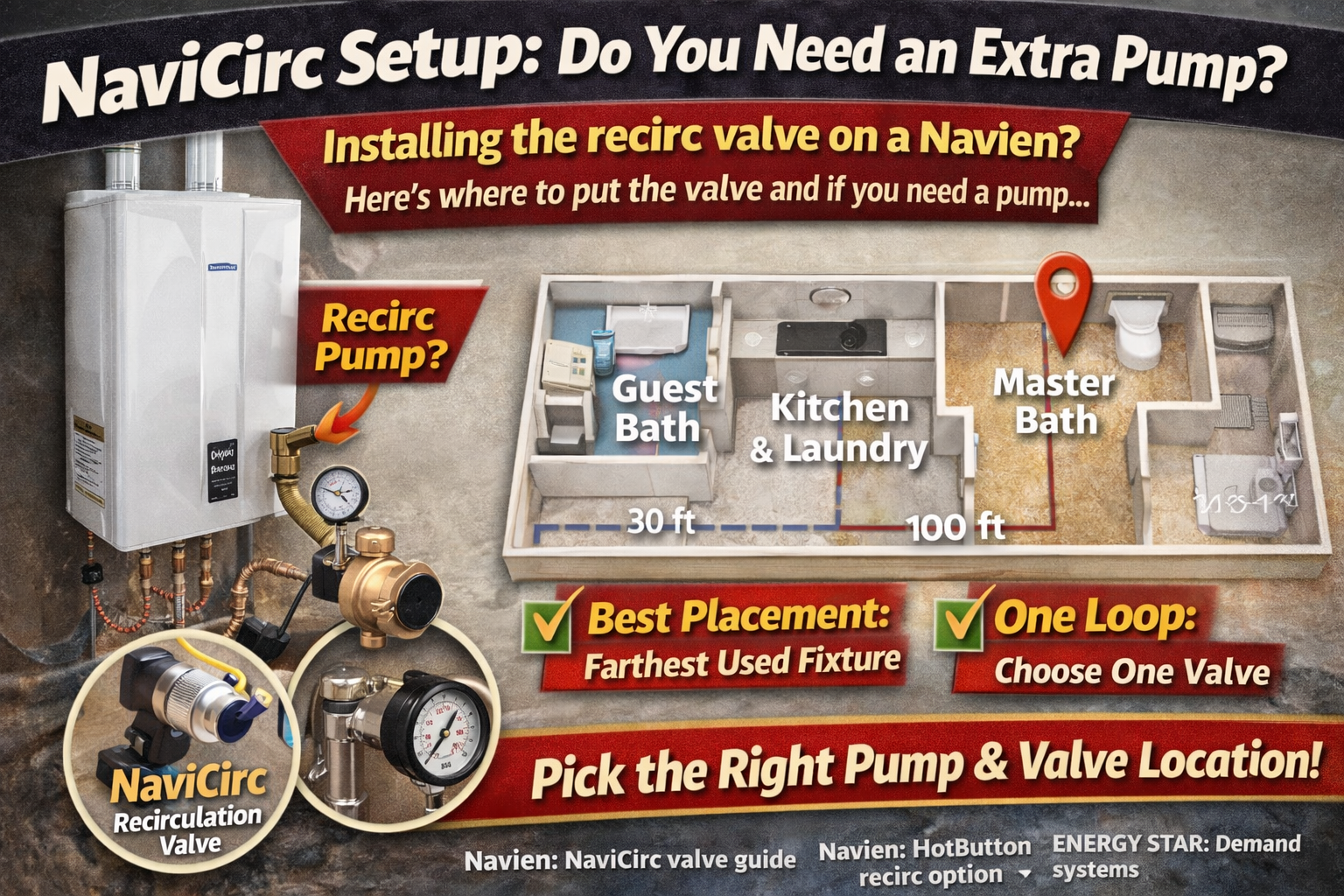
You have a Navien tankless water heater.
You want to add a NaviCirc recirculation valve.
You also want faster hot water at the tap.
Your home is new and single-level.
It is about 100 feet from end to end.
The heater is about 30 feet from one end.
The kitchen and laundry sit near the middle.
The master bath is near the other end.
Quick Q&A
Q: Should I use two NaviCirc valves in one house?
A: Start with one valve at the farthest high-use fixture. Two valves can cause extra crossover and warmer “cold” water.
What the NaviCirc valve really does
NaviCirc is a “crossover” style valve.
It connects hot and cold under one sink.
It uses the cold line as a return path.
This can cut the wait for hot water.
It can also warm the cold line for a short time.
The valve shuts down as it warms up.
That helps limit heat bleed into the cold line.
Do you really need an external pump?
It depends on your exact Navien model.
Some Navien “A” models have a built-in pump.
Those models can run recirculation without an extra pump.
Other models may need an external recirculation pump.
This is common on units without an internal pump.
It is also common on non-Navien heaters.
How to choose an external recirculation pump
Pick a pump made for domestic hot water.
Use bronze or stainless steel materials for potable water.
Avoid cast-iron pumps on drinking water lines.
Size the pump for your loop and fittings.
The NaviCirc valve is a low-flow device.
It is meant to pass about 0.5 to 1.0 GPM.
Use the NaviCirc manual specs as your baseline.
It calls for a pump with about 15 to 23 feet of max head.
That helps the valve work as intended.
Here are two example pump families to compare.
Match the pump to your pipe size and layout.
Also, match your power and control method.
Many owners prefer on-demand control.
This can save energy and reduce cold-line warming.
Where to install the valve in a long ranch home
NaviCirc works best at the farthest fixture.
That usually gives the best whole-home coverage.
But your farthest fixture may be low use.
So pick the farthest fixture you use often.
In many homes, that is the master bath sink.
This keeps your daily wait time low.
It also keeps the guest side simpler.
If the guest bath is rarely used, one valve is enough.
If you need faster hot water in two zones, consider demand control.
Demand systems run only when you ask for hot water.
- Navien: NaviCirc overview
- Navien: HotButton on-demand recirculation
- ENERGY STAR: Demand hot water recirculation
One more sizing detail to remember
Pipe length matters more than house length.
Turns, tees, and valves add friction loss.
Navien also lists equivalent length limits in the manual.
That is one reason to keep the loop simple.
Bottom line
First, confirm if your Navien has a built-in pump.
If it does, you may not need an external pump.
If you do need a pump, use bronze or stainless.
Then place one valve at the farthest high-use fixture.
Use demand control if you want tighter control.
I’m Chris Mayer, writing for Plumbing 101.