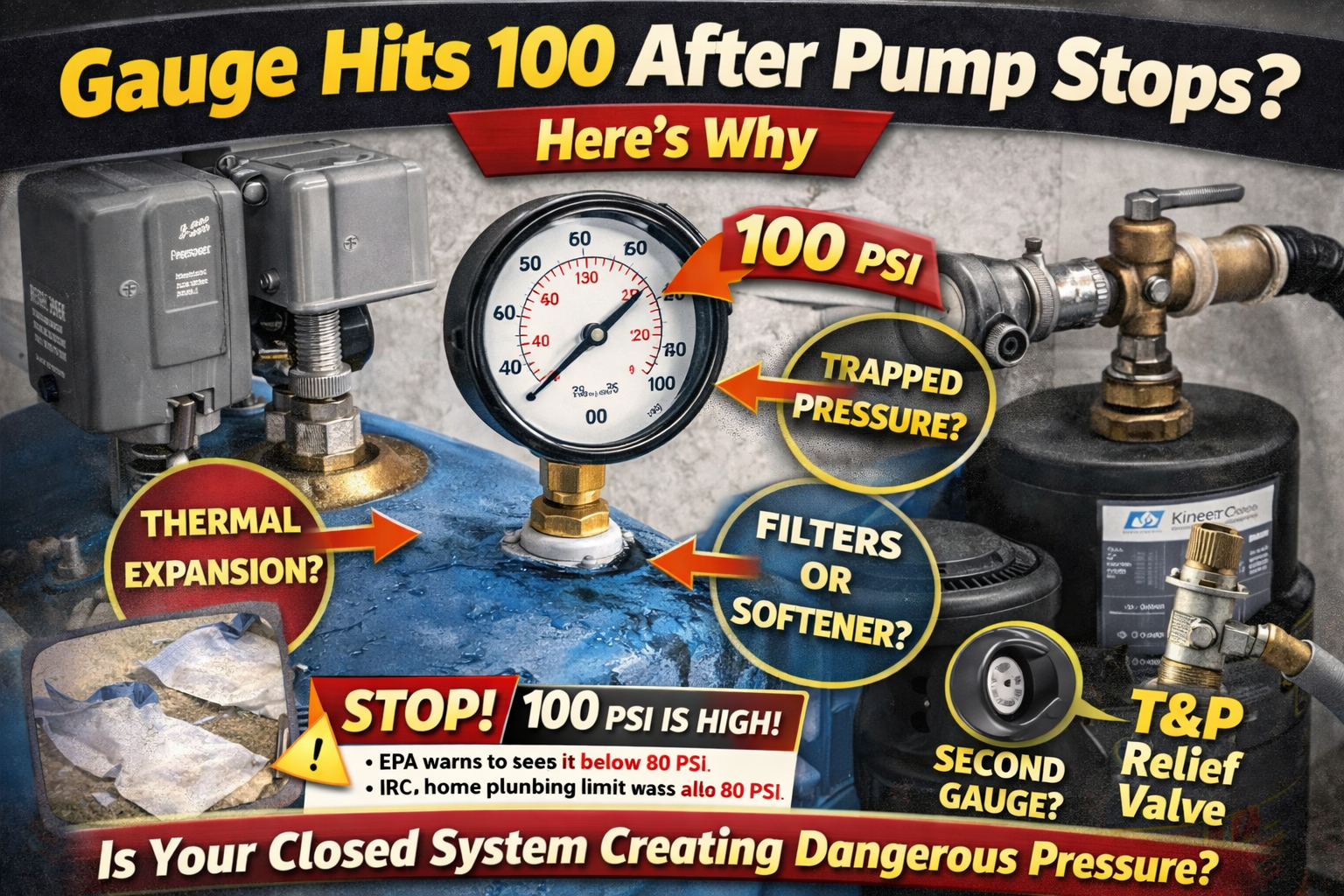
You run a 40/60 pressure switch.
Your tank precharge is set to 38 PSI.
The pump cycles as it should.
After the shutoff, the gauge creeps toward 100 PSI.
You replaced the switch and the gauge.
The strange climb still happens.
Quick Q&A
Q: Is my water pressure really climbing to 100 PSI?
A: It can be real pressure, but it may be trapped pressure in a closed section near the gauge.
What “pressure creep” usually means
A pump cannot raise pressure when it is off.
So something else is pushing the number up.
The most common cause is heat expansion.
Your water heater warms water after a refill.
Warm water expands as it heats.
If it cannot push back, pressure rises.
This can happen in a closed system.
Filters and softeners can help create that closed system.
Some installs also add a check valve by mistake.
Any one-way valve can trap water and pressure.
That can make the gauge climb with no extra flow.
Two quick tests that answer the mystery
Test 1: Turn off the water heater for one hour
Let the pump fill to 60 PSI.
Then shut off the power or gas to the water heater.
Do not change any valves.
Watch the gauge for one hour.
If the climb stops, expansion is the likely cause.
Test 2: Add a second gauge in a new spot
Screw a known good gauge onto a hose bib.
Pick one before the filters, if you can.
Use water like normal for ten minutes.
Then stop all water use.
If only one gauge climbs, the issue is local.
That points to a trapped section or check valve.
Other causes to rule out
- Pump still running. A stuck relay can ignore the switch.
- Blocked gauge port. Rust can trap pressure at a small nipple.
- Wrong gauge location. Some manifolds see spikes the tank never sees.
Listen for the pump after the shutoff.
Watch your power draw if you can.
If the pump is still running, stop and repair it.
Is it safe to run at 100 PSI?
100 PSI is high for a home.
Many plumbing rules limit static pressure to 80 PSI.
High pressure can damage valves and fixtures.
It can also trigger the water heater relief valve.
Many T&P valves are set at 150 PSI.
But you should not rely on that for daily control.
Fixes that usually solve it
- Remove any added check valve after the pressure tank.
- Check the softener bypass and any built-in backflow parts.
- Add a thermal expansion tank at the water heater, if needed.
- Match the expansion tank air charge to your system pressure.
A simple goal helps.
Keep pressure near 45 to 60 PSI for normal use.
Helpful external resources
- EPA: Service water pressure tips.
- IRC: 80 PSI maximum static pressure.
- Thermal expansion and closed systems.
- Watts: typical T&P relief ratings.
If you see 100 PSI again, do not ignore it.
Confirm with the second gauge test.
Then fix the closed system or add expansion control.
I’m Chris Mayer, writing for Plumbing 101.