Some plumbing problems never fully go away.
They may stay quiet for decades.
Then one day, a soft floor or stained wall brings them back.
That seems to be the case in this old 1910 home.
The owners bought the house nearly 40 years ago.
A few years later, they gutted the upstairs bathroom.
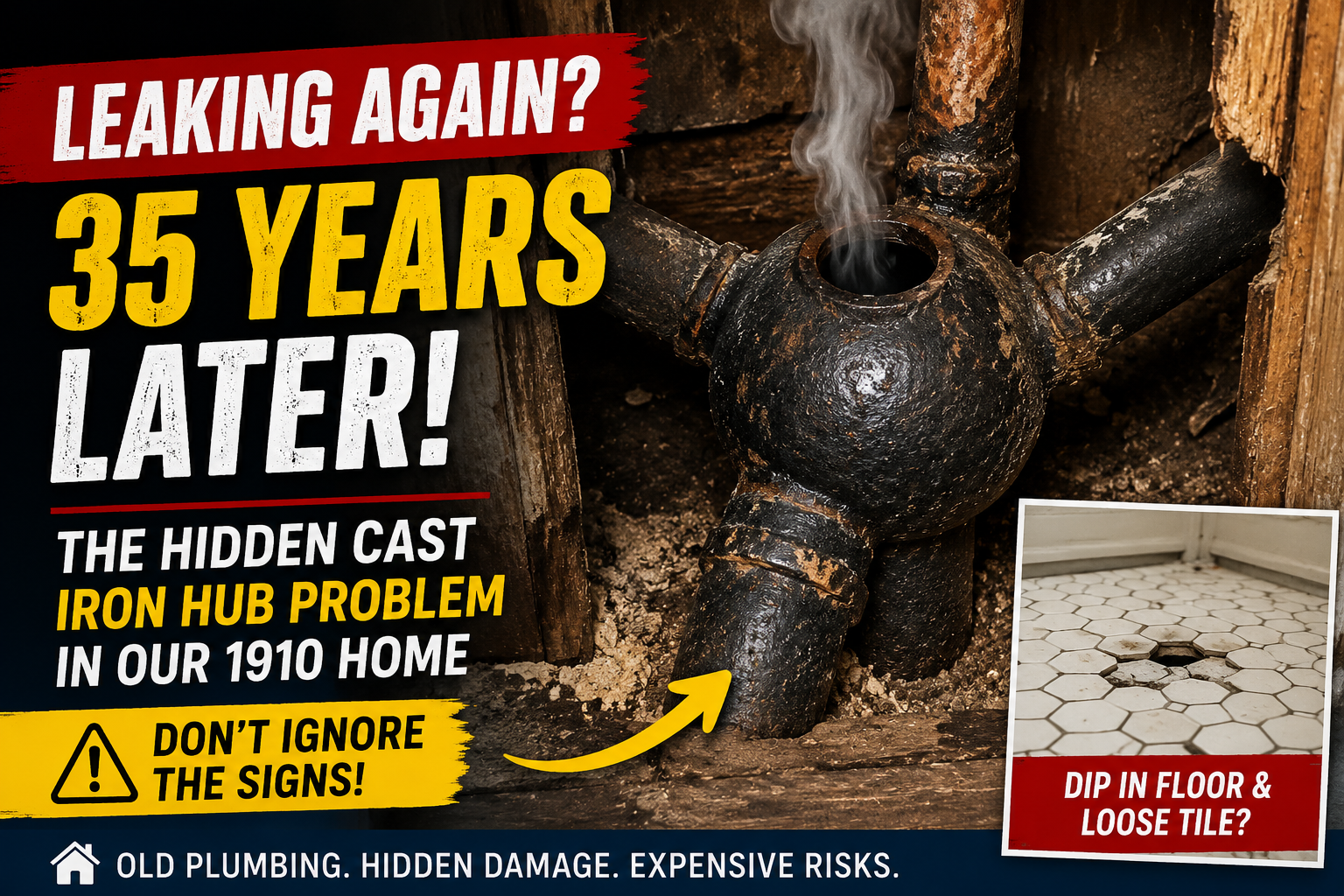
During that job, the plumber found a strange old drain hub.
It sat under the wall behind the toilet and sink.
The warning signs were already clear.
Paint and plaster were failing near the closet floor.
That damage pointed to moisture inside the wall.
The plumber opened the closet wall.
He also cut part of the closet floor.
What he found was not common modern plumbing.
The piece looked like a black iron bowling ball.
Several waste lines entered it at odd angles.
The toilet, sink, and bathtub drains are all tied into it.
One pipe dropped straight down from the bottom.
The top of the hub had a hole.
When hot water ran, steam came out of it.
Instead of replacing the old hub, the plumber patched it.
He used fiberglass and hydraulic cement.
Then the wall and floor were closed again.
That repair lasted about 35 years.
Now the same closet shows moisture damage again.
There is also a dip in the bathroom tile floor.
One small hex tile has come loose.
That matters because the floor does not get wet from above.
Moisture may be reaching the subfloor from below.
That can damage plywood and loosen tile.
It can also hide rot under a finished bathroom floor.
The smart next step is inspection, not panic.
Opening the closet wall and floor makes sense.
A small inspection camera may also help.
That can show the underside of the bathroom floor.
It may also show the old hub and tub waste line.
Cast iron plumbing can last many years.
Still, it can rust, crack, or leak at joints.
The EPA mold guide explains why hidden moisture should be fixed.
The HUD moisture guide also covers home moisture risks.
Question
Can an old patched cast-iron waste hub start leaking again?
Answer
Yes. A patch can fail after years of heat, moisture, movement, and age.
The best fix is usually to expose the area and inspect the full drain assembly.
If the hub or pipe is cracked, replacement may be safer than another patch.
This repair could stay small.
It may only need a new section of drain pipe.
But it could also become a bathroom floor repair.
If the tub waste line is cast iron, it should be checked too.
Old fittings often fail together.
The main goal is to find the leak before more damage spreads.
A licensed plumber should inspect the hub before demolition grows.
That can help avoid guesswork and wasted repair costs.
Old homes often hide odd plumbing choices.
This one may be a reminder of that fact.
A repair that worked for 35 years still may not be permanent.
I’m Chris Mayer, writing for Plumbing 101.