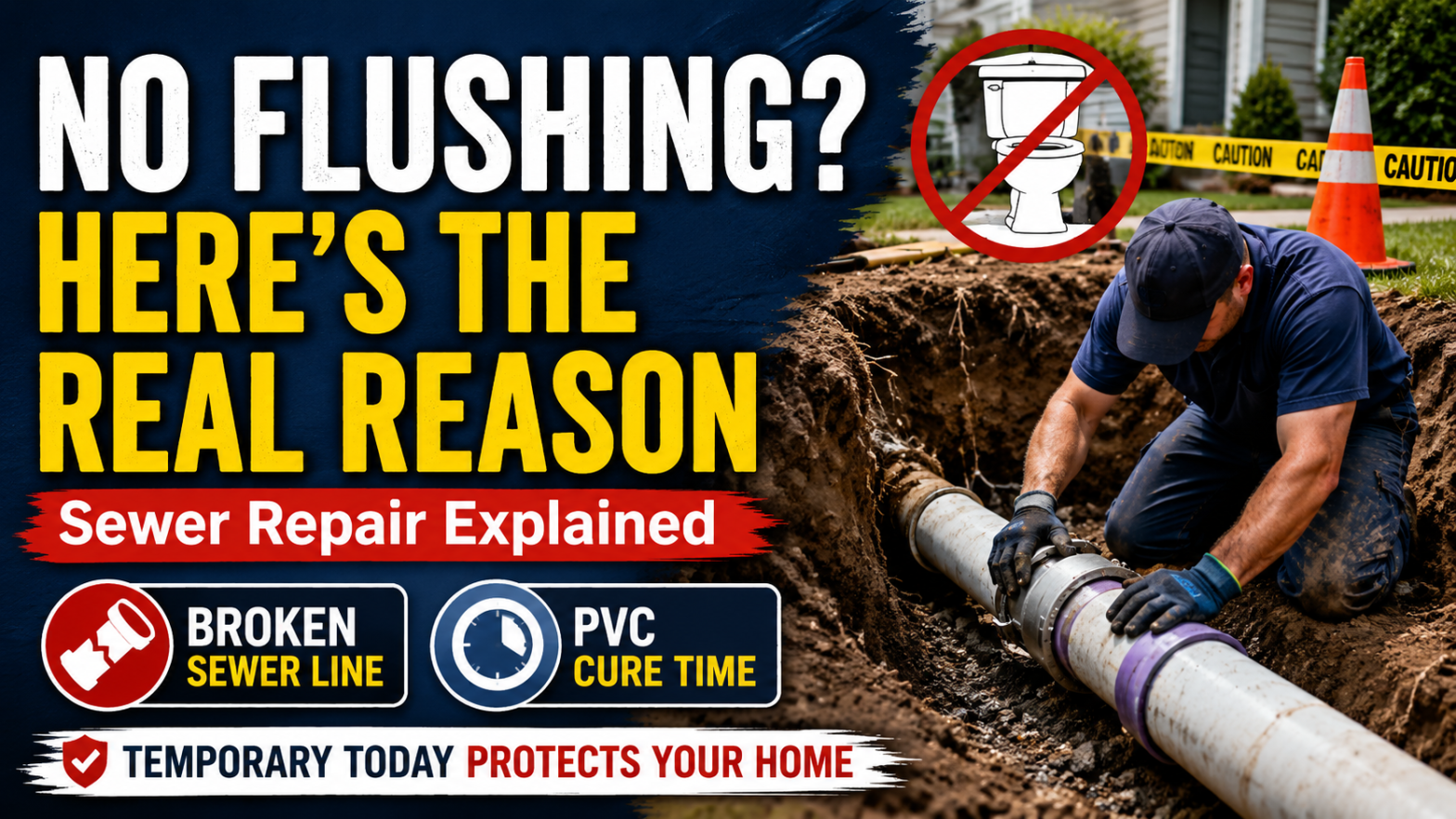
A broken sewer line can cause many questions.
This is even more true in an HOA community.
One homeowner in central Oregon had a main water leak.
A plumber came out to repair the water pipe.
During the work, the main septic or sewer pipe was damaged.
Now the plumber plans to repair both systems.
The HOA told residents not to flush toilets.
They said flushing could burst the sewer pipes.
That sounds confusing to many homeowners.
A toilet flush does not usually create high pressure.
Sewer pipes are normally gravity drain pipes.
They are not pressurized like water supply pipes.
So, one flush should not “burst” a good PVC sewer pipe.
But there is still a real concern.
If the sewer line is open, broken, or uncapped, waste can escape.
That can flood the trench or contaminate the work area.
It can also expose workers to sewage.
That is likely why the HOA said no flushing.
The wording may have been poor.
The real risk is not pipe pressure.
The real risk is sewage release.
You can read more about safe wastewater handling from the EPA septic system guide.
Question
Can flushing a toilet build enough pressure to pop PVC sewer pipes?
Answer
No, a normal toilet flush should not build enough pressure to burst a PVC sewer pipe. But flushing should be stopped if the sewer line is broken, open, uncapped, or being glued.
Why the Plumber May Say Wait Three Hours
PVC cement can feel hard and fast.
That does not mean it has fully cured.
The set time and cure time are different.
Set time means the joint can stay together.
Cure time means the joint is ready for service.
Large pipe, cold weather, and wet conditions slow curing.
Deep sewer mains may also use a larger PVC pipe.
A three-hour wait may be a safety margin.
It may also follow the cement maker’s directions.
Different PVC cements have different cure times.
Pipe size and temperature matter a lot.
You can check the general PVC cement guidance from Oatey.
Potable Water vs Sewer Pipe Glue
Potable water lines need approved materials.
Sewer lines also need the right cement.
The plumber should use primer and cement rated for that pipe.
They should also follow local code.
Ask the HOA for the plumber’s written repair plan.
Also, ask when the toilets can be used again.
Clear written instructions protect everyone.
They also help avoid damage or blame later.
For plumbing code basics, visit the International Plumbing Code.
I’m Chris Mayer, writing for Plumbing 101.